
High-Capacity Embankment Stabilisation at ARV Woollahra
Project Overview
Anchoring Rope and Rigging was engaged to deliver a comprehensive soil stabilisation solution beneath two apartment buildings at the Anglicare Retirement Village in Woollahra, in Sydney’s eastern suburbs.
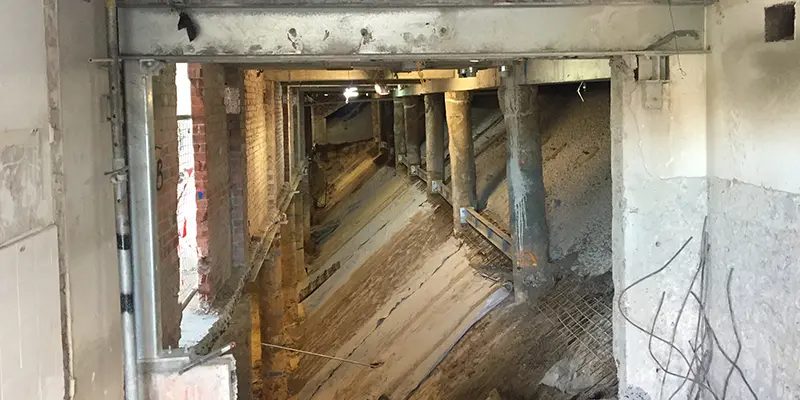
The project involved stabilising two steep soil embankments positioned directly beneath the existing buildings. Each embankment was approximately 13 metres high with a slope angle of 40 degrees, with the two treated areas measuring approximately 45 metres and 30 metres in length.
Given the location of the works, the limited access and the presence of occupied structures above, the project was considered safety-critical. The selected anchoring system needed to provide substantial verified capacity while also being practical to install within a highly restricted working environment.
A total of 206 HULK HG100 Earth Anchors, fitted with DSI thread bar tendons, were installed across the two embankments as part of a permanent slope stabilisation system.
Project Details
Location: ARV Woollahra, Sydney, New South Wales
Application: Permanent soil embankment stabilisation
Embankment height: Approximately 13 metres
Slope angle: Approximately 40 degrees
Embankment lengths: Approximately 45 metres and 30 metres
Anchor quantity: 206 HULK HG100 Earth Anchors
Anchor spacing: 1.5-metre centres
Effective anchor depth: 5 metres
Proof test load: 120 kN
Lock-off load: 75 kN
The Challenge
The two embankments were located on the underside of existing apartment buildings, creating an unusually constrained and sensitive work environment.
The limited headroom beneath the buildings meant that conventional drilling rigs, piling equipment and larger mechanical plant could not be used. Access for equipment was restricted, working space was limited, and the steep 40-degree slopes created additional installation and safety challenges.
The stabilisation system also needed to address several critical project requirements.
It had to provide a permanent and reliable restraint system for the embankments, achieve substantial design loads, be installed with minimal disturbance to the surrounding ground and structures, and allow the works to be completed in manageable stages.
The presence of residential buildings above the slopes meant that control of vibration, noise, access and construction activity was particularly important. The works needed to be carefully planned and executed without compromising the stability of the embankments during installation.
A further challenge was the scale of the project. With 206 anchors required across two long and steep embankments, the chosen solution needed to be repeatable, efficient and capable of delivering consistent installed performance.
Why HULK Earth Anchors Were Selected
 The HULK percussion-driven anchoring system was selected because it offered a complete solution to both the engineering and construction challenges presented by the site.
Unlike conventional stabilisation methods that may require large drilling rigs, extensive excavation or substantial access platforms, the HULK system could be installed using compact, handheld hydraulic equipment.
This was a decisive advantage beneath the apartment buildings, where headroom and access restrictions ruled out many traditional alternatives.
The system also offered the high installed capacity required for the project. The HULK HG100 Earth Anchors, combined with DSI thread bar tendons, provided a robust tie-back arrangement capable of resisting the loads generated by the steep embankments.
The anchors could be installed directly through the slope face, proof tested individually and then incorporated into the completed shotcrete stabilisation system.
This provided both buildability and verified performance.
The Anchoring Solution
A total of 206 HULK HG100 Earth Anchors were installed at 1.5-metre centres across the two embankments.
Each anchor was installed to an effective depth of 5 metres using a percussion-driven installation method. DSI thread bar tendons were used to connect the anchors to the reinforced slope-face system.
The anchor layout was developed to distribute restraint evenly across the embankments and provide the required resistance against slope movement.
Once installed, the anchors formed a deep mechanical connection within the stable soil mass behind the slope face. This enabled the system to provide active restraint to the embankments rather than relying solely on surface treatment.
The combination of deep anchors, thread bar tendons and shotcrete created an integrated stabilisation system designed to improve the overall stability and long-term performance of the slopes.
Installation in Restricted Headroom
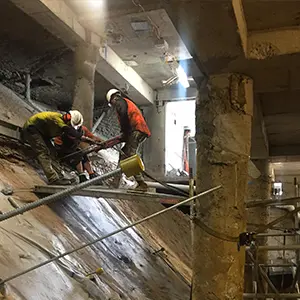 Due to the small amount of headroom available, the entire anchoring project was undertaken using handheld hydraulic breakers and compact installation equipment.
This allowed the crews to work beneath the existing buildings without requiring major access modifications or heavy machinery.
The lightweight installation equipment could be moved progressively across the steep slopes and positioned accurately at each anchor location. This was particularly important given the number of anchors and the need to maintain consistent spacing and installation geometry throughout the project.
The use of handheld hydraulic equipment also reduced the need for large working platforms and minimised disruption to the surrounding site.
Although compact, the installation system was capable of driving the HG100 anchors to the required effective depth of 5 metres and preparing each anchor for proof testing and final lock-off.
The project demonstrated that high-capacity permanent anchors can be installed successfully even where conventional machinery cannot gain access.
Staged Project Delivery
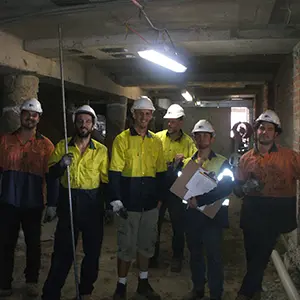
The works were completed over six separate phases using two experienced installation crews.
This staged approach allowed the stabilisation work to progress in a controlled sequence while maintaining safe conditions across the site.
Dividing the project into phases also allowed the anchor installation, testing, reinforcing and shotcrete works to be coordinated efficiently. Each section of the embankment could be completed and secured before the crews moved to the next phase.
Careful coordination was essential due to the safety-critical nature of the project and the need to work beneath existing residential structures.
The two-crew delivery model helped accelerate the program while maintaining the quality control required for each anchor installation.
Proof Testing and Verification
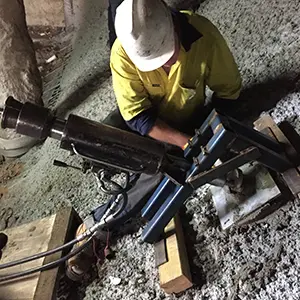 Every HULK Earth Anchor was tested to a proof load of 120 kN.
Proof testing confirmed that each installed anchor achieved the required holding capacity in the site soils before it was incorporated into the completed slope stabilisation system.
Individual anchor testing was an important part of the quality assurance process. Rather than relying only on assumed ground conditions or theoretical capacity, the installed performance of the anchors was physically verified on site.
Following completion of the shotcrete works, the anchors were locked off at 75 kN.
The lock-off process applied the required working load to the stabilisation system, helping restrain the slope face and ensure that the anchors, tendons and shotcrete acted together as an integrated structural solution.
This combination of proof testing and controlled lock-off provided confidence that the completed system was performing as designed.
Shotcrete Integration
Once the anchors and thread bar tendons were installed, the embankment faces were reinforced and shotcreted.
The shotcrete provided a durable structural facing across the slope, while the anchored tendons transferred loads from the face into the deeper, more stable soil mass.
After the shotcrete had achieved the required condition, the anchors were locked off at 75 kN.
The completed system combined surface reinforcement with deep mechanical anchorage, providing a comprehensive solution rather than a superficial treatment of the embankment face.
This was particularly important for a permanent installation beneath occupied apartment buildings, where long-term reliability and verified capacity were essential.
Project Outcome
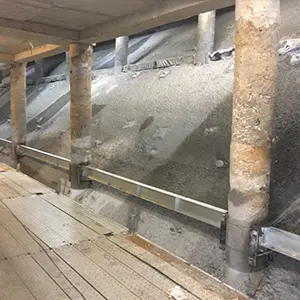 The two 13-metre-high embankments were successfully stabilised using 206 high-capacity HULK HG100 Earth Anchors.
Despite the steep slopes, limited access, low headroom and sensitive location, the anchors were installed to the required depth using only handheld hydraulic equipment.
Each anchor was proof tested to 120 kN and subsequently locked off at 75 kN following completion of the shotcrete works.
The project was delivered over six controlled phases by two experienced Anchoring Rope and Rigging crews, allowing the safety-critical works to be completed efficiently and systematically.
The HULK percussion-driven anchoring system provided the buildability required to work in an area inaccessible to conventional plant, while also achieving the substantial capacities demanded by the design.
A Complete Solution for a Complex Site
The ARV Woollahra project highlighted the versatility of HULK Earth Anchors in difficult ground engineering applications.
The system provided more than simply an anchor product. It delivered a complete installed solution incorporating site-specific planning, compact installation equipment, high-capacity anchors, engineered tendons, proof testing, controlled lock-off and experienced installation crews.
Backed by the practical knowledge of Anchoring Rope and Rigging, the HULK mechanical ground anchoring system offered a cost-effective and buildable alternative to more disruptive conventional methods.
The project demonstrated the suitability of HULK Earth Anchors for:
- Steep embankment stabilisation
- Permanent slope restraint
- Restricted-access geotechnical works
- Projects beneath existing structures
- Anchored shotcrete systems
- High-capacity soil retention
- Safety-critical remedial construction
The completed works provided a permanent and verified stabilisation solution while overcoming some of the most challenging access and installation constraints encountered in urban geotechnical construction.